


Last time, we looked at how bodies slowly lose resilience when nutrition no longer supports repair and renewal. This piece follows that same thread - at a smaller scale and one layer deeper - into the chemistry behind that process.
Don’t worry, the chemistry is minimal, and the insights are practical. My promise is that ten minutes from now, you’ll understand something useful about how your body actually works - and you’ll have a much simpler way of thinking about health.

Health = Damage vs Defense + Repair
From a first principles standpoint, health is simple:
It’s the balance between damage and defense + repair.
Every day, two things are happening at once:
The body is exposed to things that create damage.
The body activates resources to neutralize and repair that damage.
When defense stays ahead of damage, the system remains resilient. When damage consistently outpaces defense, the body begins to break down.
This is the foundation of the “Free Radical vs Antioxidant” framework, where:
Free radicals represent a major form of damage.
Antioxidants represent the body’s primary line of defense.
What Is a Free Radical?
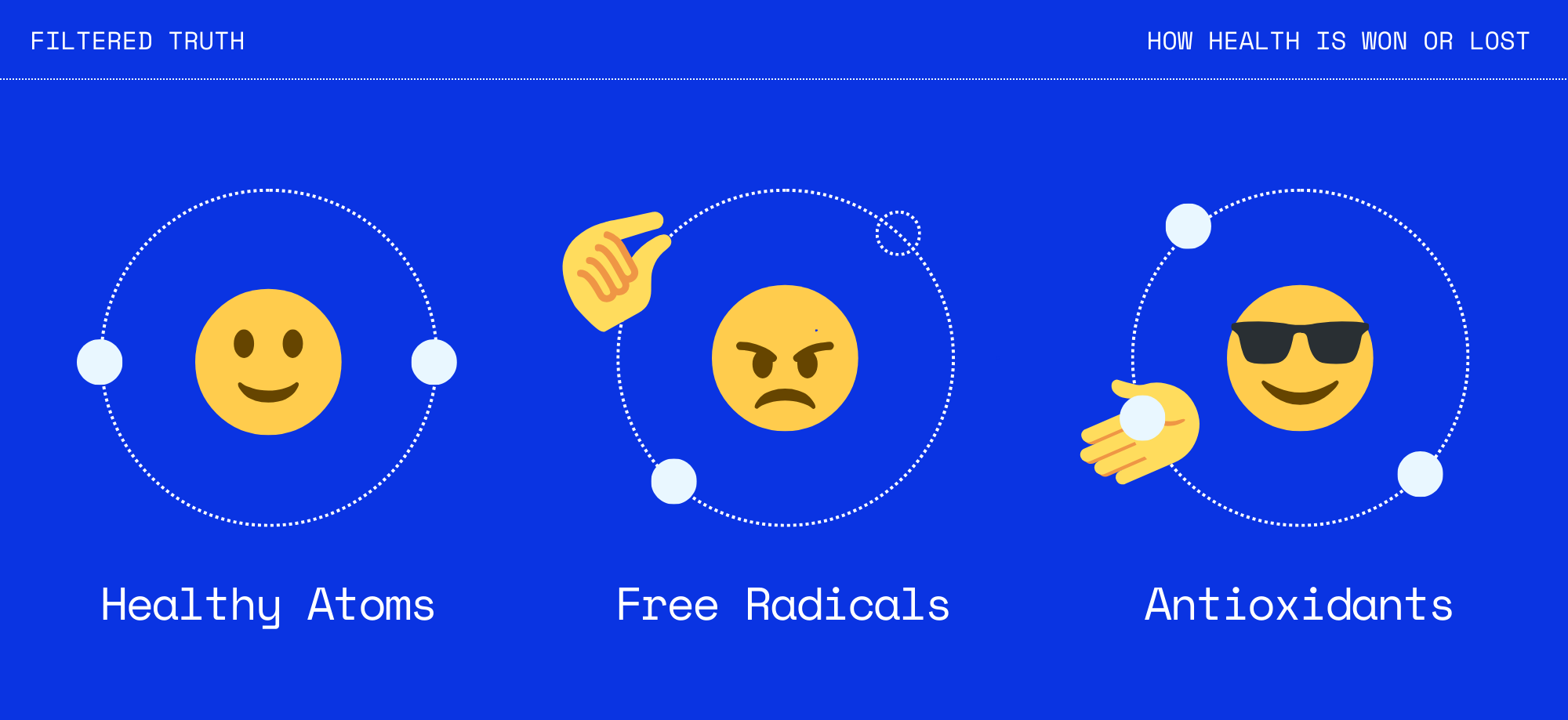
At its core, a free radical is simply an unstable molecule missing an electron.
Electrons like to exist in pairs, and when a molecule is short one, it becomes reactive - constantly looking to stabilize itself by taking an electron from somewhere else. Think of it like a restaurant table with a missing chair: someone is left standing, looking for a place to sit, so they pull a chair from the next table…
That act of “electron theft” is what creates damage.
One missing chair isn’t a crisis (the servers can adjust), but when chairs keep getting pulled from table to table, the whole room gradually loses order.

Unfortunately, modern life exposes us to a high free radical load.
Some of the most common sources include:
Ultra-Processed Foods: Foods made with damaged oils, chemicals, dyes, and preservatives. Think fast food, fried food, and packaged snacks.
Pesticides + Dirty Food/Water: Small amounts of chemicals that get into food and water from things like pesticides and plastic. Over time, they add up.
Air Pollution + Smoke + Indoor Chemicals: The lungs let things into the body very quickly - what you breathe goes straight into the bloodstream. Examples include car exhaust, smoke, cleaning sprays, perfumes and scented candles.
Chronic Psychological Stress: Stress isn’t just “mental” - it changes your body chemistry. Too much stress makes it harder for the body to fix itself.
Poor Sleep + Light at Night: The body does a lot of repair while you sleep.
Bright lights and screens at night shut down that repair.
What Are Antioxidants?
Antioxidants are protective molecules that neutralize free radicals.
They work by donating an electron safely - without becoming unstable themselves. Instead of free radicals stealing electrons from your tissues, antioxidants offer one first, stopping the chain reaction.
That said, antioxidant protection isn’t just about taking vitamins or eating “superfoods.” It’s a whole system the body uses to protect itself and fix damage - and that system also needs rest and time to work.

Nutrient-Dense Animal Foods: Many helpful foods don’t stop damage directly. Instead, they help the body build the tools it needs to protect and repair itself. Egg yolks help protect cell walls; oysters provide minerals that help repair cells; beef liver gives vitamins and minerals the body uses for protection, etc.
Sunlight: Sunlight supports antioxidant capacity by improving circadian rhythm and mitochondrial efficiency. Better-functioning mitochondria leak fewer free radicals to begin with - reducing oxidative stress upstream.
Sleep: Sleep is when repair actually happens. Deep sleep restores antioxidant reserves, clears damaged cells, regulates hormones, and supports detoxification.
When Damage Outpaces Defense + Repair
This is where the model becomes especially clear.
Up to this point, we’ve been talking about chemistry at the cellular level, but none of this stays isolated. Free radicals and antioxidants don’t just act inside individual cells - they move through the body in the bloodstream.
And blood, by design, goes everywhere. It reaches the brain, heart, liver, kidneys, glands, joints, and nerves. Anything circulating in blood becomes systemic.
When antioxidant capacity is sufficient, free radicals are neutralized quickly and damage stays contained. When free radicals exceed that capacity, they remain active - circulating, colliding with tissues, and repeating the same injuries over and over.
This state is called oxidative stress:
Oxidative stress simply means that damage is occurring faster than the body can neutralize and repair it. And because blood touches everything, oxidative stress doesn’t stay localized. It shows up as whole-body wear and tear.

When oxidative stress begins to tip the balance, the first signs are often subtle and scattered:
Brain fog and headaches
Poor sleep and fatigue or low stamina
Irritability and mood instability
Muscle twitching or cramps (often mineral-related)
Chronic inflammation or pain
Slower recovery after workouts
Skin changes (aging, dryness, inflammation)
Digestive issues
These patterns are signs the body is losing its oxidative balance.

When free radicals stay elevated, small injuries start to build up all over the body:
Brain ⇢ the brain’s energy parts get damaged ⇢ thinking and focus get harder
Heart ⇢ vessel walls get worn down ⇢ circulation doesn’t work as well
Liver ⇢ the body runs low on important helpers ⇢ cleaning and detox slow down
Kidneys ⇢ constant strain on filters ⇢ tissues wear out over time
Hormones ⇢ disrupted signaling ⇢ energy, mood, and growth get off balance
Joints ⇢ support tissue breaks down ⇢ stiffness and long-term pain
This doesn’t always show up right away, because the body is good at adjusting (it can cover for problems for a long time), but the damage does eventually add up - like rust slowly spreading under the surface.
Winning the Long Game
Back to the top with a better understanding.
Health, at its core, reflects a balance:
Free radicals are the chemistry of breakdown.
Antioxidants are the currency of defense and repair.
Health depends on which side wins over time.
The aim, then, isn’t to eliminate damage - it’s to stay ahead of it.
Which means:
Reducing unnecessary sources of damage
Building real antioxidant capacity
Protecting mitochondrial function
Prioritizing sunlight and sleep, and
Using nutrient-dense foods that actually supply repair materials

I’ll be sharing more detailed guides on food and behaviors soon. I wanted to start with the context first - so the conviction to act is grounded, not rushed.
In the meantime, I won’t leave you empty-handed. Here’s a good place to start:
Filter your water. Use a high-quality filtration system - ideally reverse osmosis. RO filtration removes microplastics, heavy metals, chlorine byproducts, fluoride, and other contaminants that push your antioxidant system into constant overwork.
Choose organic when possible. Organic foods reduce exposure to pesticides, herbicides, and synthetic chemicals that add to oxidative stress over time. When sourcing is unclear, prioritize foods where chemical load matters most.
Source food closer to its origin. Directories like EatWild.com and RealMilk.com help you find regenerative farms, grass-fed meat, pastured eggs, and unprocessed dairy - foods that preserve the minerals, enzymes, and fat-soluble nutrients the body uses for repair.
Use heat intentionally. Incorporating sauna into your weekly rhythm improves circulation, strengthens mitochondrial resilience, and activates detox pathways that help clear the byproducts of oxidative stress.
These aren’t “hacks” or “optimizations.” They’re just fundamental ways of lightening the daily damage burden and increasing the resources your body has for defense, repair, and long-term resilience.
That’s the direction we’ll keep moving in.